Amidst a slew of new hardware announcements during its mini iPad event, Apple decided to sneak in what has already caused a significant stir amongst a great many “new iPad” (aka iPad 3) users who’ve all plunked down a lot of dollars over the last six months for it. That now makes the new iPad the "old new" iPad. What exactly has Apple been thinking and why has it unexpectedly snuck a 4th generation iPad announcement into the mix today?
Some of us believe it comes down to one simple thing – the Lightening connector. More on that in a bit.
The “new new” iPad 4th gen will sport an A6X processor. The iPhone 5 uses Apple’s new A6 processor – and at the time of the iPhone 5’s release there was a lot of discussion around this. Historically (or at least given as much history as one can impute to a history that only goes back several years), the iPad has been the platform of choice for Apple to reveal new processors, and many had thought the iPhone 5 would have an upgraded A5 processor rather than an A6 for this reason. That did not turn out to be the case, but the iPad 4th gen’s A6X now brings everything back into historical stasis. When the next iteration of the iPhone 5 emerges it will probably sport the A6X.
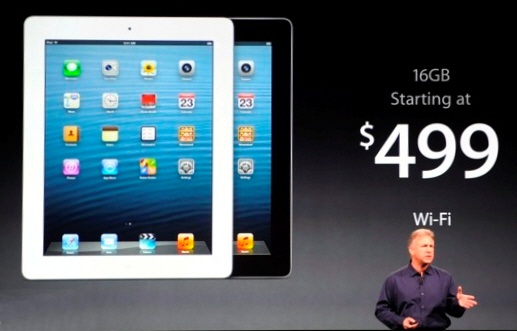
The one key difference is that the A6 is a tri-core design and the A6X is a quad-core design. More cores, better overall hardware and software management at every level, which also translates to better speed. Of course. Or possibly. It isn’t clear to us yet that the performance difference will be anything non-trivial. But history is now preserved.
Interestingly, the A6 delivers a significant advantage over the older A5 in terms of power consumption. This was of key importance to Apple when designing the iPhone 5, in that Apple needed to find a way to offset the additional power consumption the iPhone 5’s LTE radio (itself a rather excellent design relative to power consumption) would demand. So it is interesting to us that the iPad mini sports an A5, which could not have really saved Apple all that much in terms of per device manufacturing cost.
We can only assume here that once the first 10 million run of iPad minis is out the door, and following the holiday buying season, Apple will have a ready-made upgrade in hand for the "next generation" mini it will no doubt deliver in the first half of next year - one sporting the A6. Meanwhile, look for the iPad 2 to be retired when the old mini becomes Apple's sub-$200 device at that time, and look for the "old new" iPad to become the low end big iPad (perhaps repackaged to include a Lightening connector adaptor) until all supplies finally run out to build them. That finally positions the old new iPad (complete with retina display) to become Apple's next "affordable enterprise workhorse."
A User Furor!
Regardless of potential Apple strategies, the end result of introducing the 4th gen is that a great many people that have purchased "old new" iPads over the last six - seven months and are now left holding the technology bag. They no longer own the coolest iPad on the street - they own old stuff. This obviously reminds us of Apple's very first issue of this sort, when it introduced an improved iPhone 3 shortly after the original iPhone went on sale. That event caused enough consumer noise that Apple offered all original iPhone owners a $100 rebate (or credit disguised as a rebate).
Will we see Apple do the same here? Perhaps they will now offer old new iPad users a free Lightening adaptor to soften the blow. That makes for a good segue - what exactly will Apple be offering in the new iPad 4th gen that is so compelling that Apple felt a need to introduce it at the mini event, and at the risk of causing old new iPad user fury?
We confess that we are scratching our heads over this one. But should we?
Cool New Stuff
In addition to the A6X processor we noted above, the 4th gen iPad will deliver a new image signal processor, an upgraded FaceTime camera, expanded LTE (meaning it will be usable across more countries), and 2x faster Wi-Fi (with 802.11n and support for both 2.4GHz and 5GHz). And, of course, the Lightning connector.
Let's face it - there isn't a whole lot of technology there that the company could not have waited another six months to introduce.
With one key exception - the Lightening connector.
The connector appears to be of significant importance to Apple - the sooner its current and new devices overwhelm the population of old connector devices the better it will be for Apple. More importantly, the better it will be for Apple's emerging hardware ecosystem - and this is the key to the 4th gen iPad intro taking place during the iPad mini event rather than another five months down the road.
There are, no doubt, some new and potentially exciting hardware innovations coming down the road - likely the currently mythical Apple TV will finally appear, for example.
Apple is now fully committed to delivering all new technology with the Lightening connector, of course, and it needs to wean its user ecosystem off the old connectors as quickly as possible. The consumers most likely to move quickly to upgrade are the loyalist Appleytes - but there are so many of them within the Apple user ecosystem that Apple can afford to anger those who aren't true acolytes but merely happy Apple users. It is the Appleytes who will flock to future Apple hardware first, and Apple needs to have them in place with Lightening connector devices in order to deliver the cool new stuff.
We've written for some months now that Apple needs to return to a path of innovation - and that it needs to get off the litigation bandwagon. We believe that the first half of 2013 will indeed finally bring new Apple innovation - and as difficult as it may be to intuitively attach any significance to the Lightening connector on the innovation front, it will play a significant role for Apple going forward.
What, you don't believe us? Let's reconnect in five months or so and compare notes then.
Edited by
Brooke Neuman

 QUICK LINKS