Can T-Mobile USA disrupt the U.S. mobile market? Let’s be clear: T-Mobile USA has not actually said it intends to “disrupt” the U.S. mobile business. Instead, T-Mobile USA has only said it does not want to “act like a mobile company.”
So can it do that? If leaked plans prove to be accurate, no.
T-Mobile USA might not even succeed at becoming an “uncarrier,” and it hasn’t even launched those plans yet.
A memo suggests T-Mobile is revamping plans in the near future to make unlimited talk and text a de facto part of the experience, where data would be the only changeable factor.
Unlimited (presumably domestic) calling and (presumably domestic) texting are touted as features of the new approach. One might be tempted to yawn; that’s what AT&T and Verizon Wireless already are doing.
The new T-Mobile USA plan will reportedly make Internet access usage buckets the variable cost, where voice and texting are fixed costs, embedded in the network access connection. One might argue that means T-Mobile USA, in an effort to distinguish itself from other mobile service providers, is just copying them.
T-Mobile USA has also made much of its shift to “non-subsidized” devices. But since it offers installment plans, what’s the real difference? And what would it take for the other leading service providers to offer their own installment plans?
The big shift would have been to abandon all device subsidies, completely, with no installment plans. That T-Mobile USA did not take that tack betrays an understanding it really cannot do and hope to grow share with.
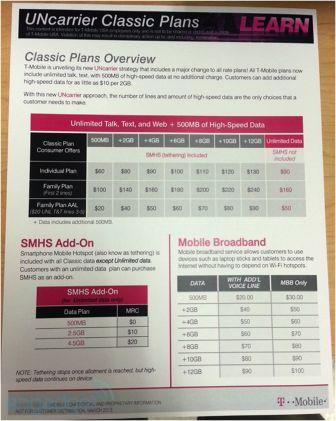
One hates to evaluate a brand new retail “go to market” plan before it has launched. And it is possible the reported approach is not correct. But if it is, T-Mobile USA will have failed to take sufficiently bold steps to back up its “uncarrier” claims.
“Move along, these aren’t the droids you’re looking for.”
Edited by
Braden Becker

 QUICK LINKS