Veteran virtualization, cloud and mobility enterprise vendor Citrix has just released a new enterprise report - this one focusing on the use of cloud-based mobility technology. The company - which recently acquired Zenprise in order to add to its mobile device and app management capabilities - has uncovered a very interesting set of trends that are worth exploring. The Citrix Enterprise Cloud Mobility Report for Q4 2012 is based on aggregate data from Citrix customers who have deployed enterprise mobility in the cloud.
Let's jump directly in to the most interesting finding. Android (or maybe we should say Samsung's Android devices) have certainly gained a great deal of market share over the last year. Along with the increase in market share, there has also been a lot of hype about the "demise" of Apple, iOS, and the dominance of Apple mobile devices. To be sure, Apple certainly no longer owns 100 percent of every market.
This however, was never a sustainable reality. As competition enters the market - especially the enterprise market - the dynamic must inevitably shift downward for the company that defined the market. Why so many pundits and financial analysts insist on measuring Apple in a way that precludes the inevitable effect of competitors is beyond us. Apple had to lose market share - it is inevitable. So, with all the noise and hype now surrounding Android, Google and Samsung, and given the inevitability of Apple market share declining, what has Citrix uncovered?
Well, to begin with, regardless of the significant increases in Android hardware across all global regions, when it comes to the enterprise Apple iOS and Apple hardware still maintains a major lead in enterprise mobility within every global region. The chart below shows just how dominant iOS remains even in the face of significant competition.
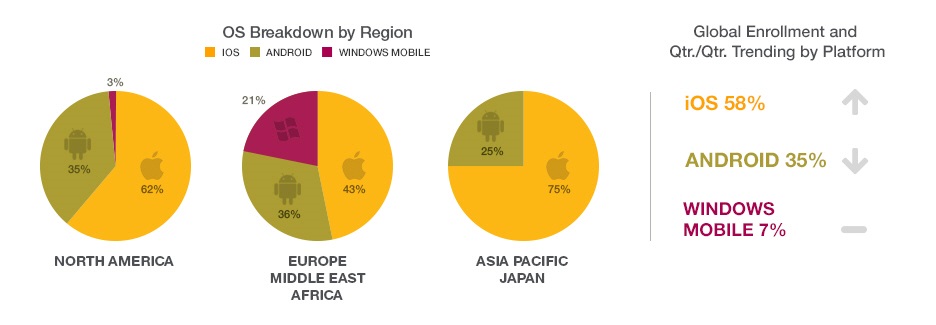
One of the things that is particularly interesting to us is that Windows Mobile (not Windows Phone 8, but the old school Windows Mobile OS) is still so prevalent. This may actually be due to the use of ruggedized devices in some parts of Africa and other rough and tumble field service EMEA regions, where the move to either iOS or Android has not seemed appropriate.
Another very interesting result here is that though Android is making all sorts of market penetration headlines in the Asia Pacific region, clearly this is taking place on the low end consumer side of things and not in the enterprise where higher end devices are more prevalent. Apple maintains a still-dominant 75 percent share here. To a possibly large extent Japan - which clearly loves its iPhones and iPads (and clearly isn't as interested in its South Korean counterparts - which may be an historical anomaly but never the less quite real), may be influencing this. It will be interesting to see if it changes over the next two quarters.
As hard as it may seem to believe, a number of ruggedized device makers are still using Windows Mobile. Even so, iOS still owns the largest share of the market, and we suspect that a year from now the numbers will show stabilization that more or less mirrors what we see today - although Windows Mobile will absolutely decline even in the EMEA region at the expense of both iOS and Android.
Compared to the previous quarter, Citrix notes that Android lost two percentage points globally and Windows Mobile remained the same at seven percent of devices. Android was never the less the fastest growing platform for enrolled devices in Europe, the Middle East, and Africa with an 11 percent gain from the prior quarter to 36 percent of the region. Apple saw its iOS penetration drop from 56 percent to 43 percent share of enrolled devices in the same region, and Windows Mobile actually gained two percent share to 21 percent (though as we noted earlier we anticipate Windows Mobile will begin a real decline here).
Vertical Trends - Some Android Gains
Citrix also finds that iOS is also the preferred platform in many vertical industries, with retail and restaurants definitely remaining loyal to Apple. That said, the following chart shows some very interesting developments - and in fact shows that Android is making real inroads in several areas.
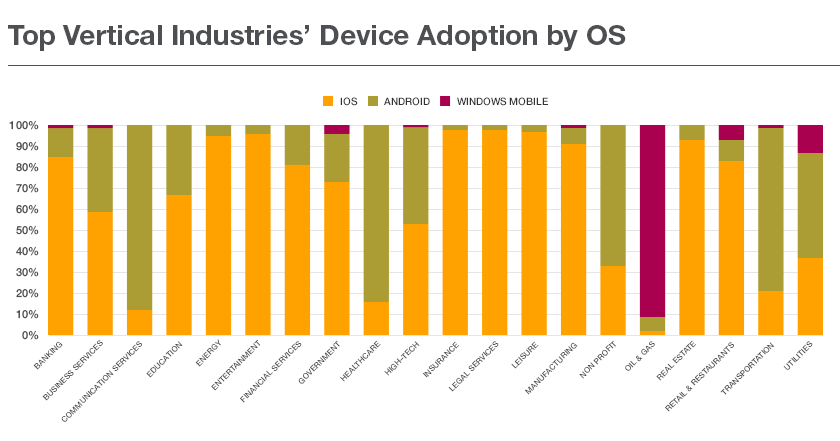
Some of the numbers here are fully to be expected. For example, the prevalence of Windows Mobile in the oil and gas industries is certainly to be expected. These environments require special ruggedized hardware that in many cases needs to meet certain levels of safety certification and to date these mostly fall in the Windows Mobile camp.
One vertical where we did not expect Android to dominate is the healthcare industry. Apple iPads and iPhones have completely dominated this market segment since the original iPad emerged in 2010. Even though we are well aware that some enterprise-focused hardware vendors have turned to Android as the Windows Mobile alternative within healthcare (since of course iOS is an Apple only OS), we would not have guessed that the balance has tipped so much in Android's favor. Citrix further notes that the majority of healthcare respondents are home healthcare organizations that have deployed cloud-based enterprise mobility - though that doesn't completely explain why they would prefer Android over iOS.
Utilities, communications services and transportation show similar deep penetration, though here we would have expected deeper Android penetration - though not nearly as much as the Citrix data says is the case. Citrix itself believes that this is due to the high preponderance of field service activity in these industries. This makes a good deal of sense and again likely ties back to the ruggedized players turning to Android in markets where "less ruggedized than oil and gas" devices are still preferred to standard issue, non-ruggedized iPads. Android's market share here certainly suggests that Android tablets have a significant future ahead of them.
Conversely, iOS is clearly the preferred platform within verticals where mobile users engage their customers one-on-one, such as in retail and restaurants, as well as the legal and insurance industries. Within these verticals iOS maintains sizable market share.
Mobile App Management Trends
Finally, Citrix has also uncovered an interesting mobile app enterprise patter. The results here aren't at all surprising. They do indicate that enterprises are clearly coming around to understanding that mobility offers both advantages and potentially serious threats.
Specifically, businesses have become more aggressive on app blacklisting, with 18 percent of customers deploying this policy, an increase of 11 percent from the prior quarter. Often associated with corporate-issued line-of-business use cases, a rise in blacklisting indicates an increase in such deployments.
Typically, organizations blacklist apps they feel pose a threat to data or network security, such as apps that synchronize and share files outside of the corporate network. Some also blacklist apps that are considered a drain on productivity, such as games and social media. This is especially true for devices used for workers doing task-based activities.
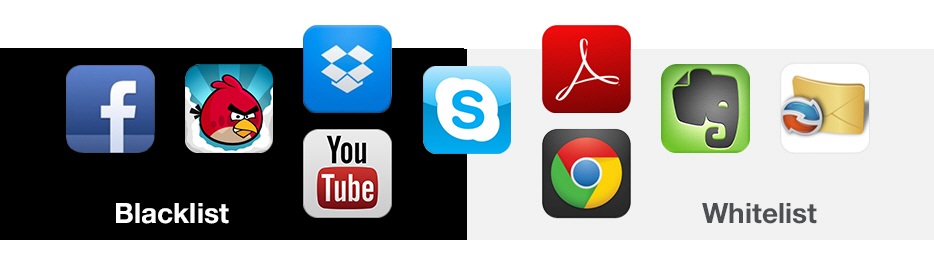
As the chart above highlights, the most commonly blacklisted apps were - again there should be no surprises here - Angry Birds, Facebook, Dropbox, and YouTube, while the most commonly whitelisted apps were Evernote, NitroDesk TouchDown, Google Chrome and Adobe Reader. Skype was the only app that made both the blacklist and whitelist. Dropbox of course isn't a game but a personally useful tool that never the less allows workplace users to potentially circumvent data security policies (even if for the most part that circumvention is entirely unintentional).
As more MDM/MAM vendors - including Citrix itself with its XenMobile and XenMDM platforms - deploy more of their services within the enterprise we may see a shift away from overt blacklisting. For now it's a smart move.
For more details and additional charts make sure to check out the report itself - it is available as a free PDF download.
Edited by
Brooke Neuman 
 QUICK LINKS