One feature of the 21st century communications business is the more diverse set of business strategies service providers can choose to adopt, even though in the past, nearly all companies had very similar strategies. Consider the issue of “mobile” service. Most tier-one telcos long ago, decided they must be in the mobile business directly.
BT is one of the few tier-one telcos globally who does not own a facilities-based mobile operation, as a result of its 2001 decision to sell its mobile assets (Cellnet) because of a major debt reduction program. Those assets in turn were acquired by Telefónica in 2005.
Of the 10 largest telecom service providers in the world, only one does not have a facilities-based, owned-spectrum, mobility business- and that one provider is Comcast, the U.S. cable company.
In that sense, BT has been in a strategic position analogous to major U.S. cable operators, who are not facilities-based and have significant mobile operations, and for the moment rely on partnerships to sell mobile service on an “agency” basis.
For nearly a decade, though, BT has operated what might be called a “smallish” mobile business on a mobile virtual network operator basis, using Vodafone assets. That in turn, likely became uncomfortable after Vodafone acquired Cable & Wireless Worldwide, BT’s UK-based network rival.
But, BT has won fourth generation spectrum in the recent U.K. spectrum auctions, signaling a return to the facilities-based mobile business, in some way. The issue is what path BT might take, as it faces entrenched competitors with much more spectrum.
Everything Everywhere Ltd, Hutchison 3G UK Ltd, Niche Spectrum Ventures Ltd. (a subsidiary of BT Group plc), Telefónica UK Ltd. and Vodafone Ltd. all won spectrum in the 4G auction, and all of those other providers already have spectrum assets deployed.
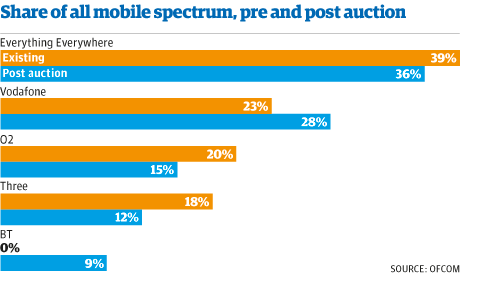
BT’s own spectrum in the 4G bands includes two 15 MHz holdings at 2.6 GHz and one 20 MHz allocation also in the 2.6 GHz band. That represents about nine percent of all mobile spectrum in commercial use, once all the new 4G networks are activated. EE will have 36 percent of all spectrum, Vodafone 28 percent, O2 15 percent and Three 12 percent. So BT will be back in the mobile business, but as the contestant with the least spectrum. That will constrain BT’s options.
Edited by
Stefania Viscusi 
 QUICK LINKS