With the completion of the T-Mobile USA reverse merger with MetroPCS Communications, the company has begun trading on the New York Stock Exchange under the ticker TMUS.
With the Dish Network bid for Sprint yet unresolved, and with Dish Network also having made approaches to T-Mobile USA, one wonders whether a next round of consolidation will occur, uniting Dish Network with T-Mobile, for example.
Beyond that, some observers still would argue that, eventually, even Sprint and T-Mobile are destined to combine. The reason is that on virtually every key financial or operating metric, T-Mobile USA and Sprint trail AT&T and Verizon significantly.
And while AT&T and Verizon Wireless continue to add customers, in some cases at a faster rate, both Sprint and Nextel are struggling to avoid losing customers, especially the more valuable postpaid customers.
The new company would have had 2012 revenue of $24.8 billion, $6.4 billion of adjusted EBITDA, $3.7 billion of capital expenditures (excluding spectrum purchases) and $2.7 billion of free cash flow.
But AT&T had $123.4 billion 2012 revenue, with $66.8 billion from AT&T Mobility.
Verizon Wireless had $75.9 billion in 2012 revenue, while Verizon Communications had $116.8 billion in 2012 revenue.
Sprint had $35.3 billion in annual revenues.
But only Verizon and AT&T actually had positive operating income on their respective revenues.
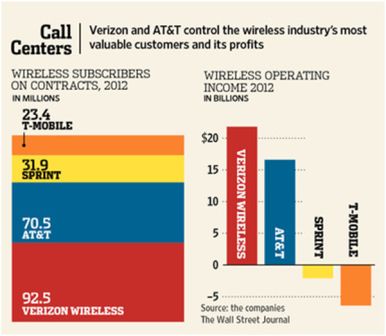
T-Mobile USA will have 43 million subscribers as of March 31, 2013, but a great percentage of those customers are on contracts. T-Mobile USA has about 23.4 million contract customers, compared to 70.5 at AT&T and 92.5 million at Verizon Wireless.
T-Mobile USA is targeting 2012 to 2017 compounded annual growth rates in the range of 3 to 5 percent for revenues, 7 to 10 percent, 3 to 5 percent for revenues, 7 percent to 10 percent for EBITDA and 15 percent to 20 percent for free cash flow.
The new firm also expects cost synergies of $6 billion to $7 billion (net present value).
Whether any of that will be enough to allow T-Mobile USA to gain market share, though, is the question. The same issue can be asked for Sprint.
But if Dish Network does not win Sprint, it likely will try to combine in some way with T-Mobile USA. Some continue to believe an eventual combination of Sprint and T-Mobile could still be “necessary,” if Verizon and AT&T continue to pull away from the other two carriers.

 QUICK LINKS