Wal-Mart - most certainly a company that thrives at the highest levels of the technology food chain, especially when it comes to such things as automated warehousing, RFID, ERP and a host of other supply chain technologies, has also long embraced mobile field services technology. Over the last several years Wal-Mart has also invested in using mobile technology at the direct retail level, to find ways to both entice smartphone-wielding customers to shop smarter (and spend more in the process) and to proactively respond to consumers and what they need.
Now, Wal-Mart is taking another mobile leading edge step by introducing its new "Scan and Go" service, which will allow consumers to scan items directly through their smartphones as they shop and will then allow those consumers to do their checkouts directly at special mobile-enabled kiosks. Wal-Mart employees are currently testing the mobile payment system, which allows consumers to completely bypass the checkout isles and completely bypass having to work through cashiers.
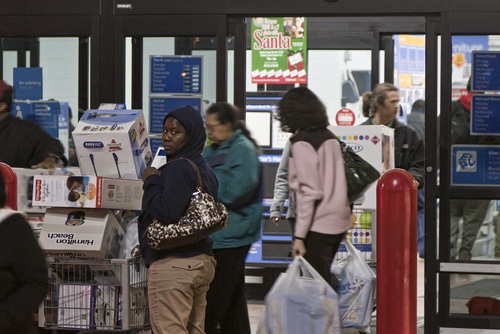
Image via Shutterstock
It is not really any different than making use of typical self-service checkout lanes, but the real difference of course is that when the user arrives at the mobile checkout kiosk everything is already scanned and totaled up - all that actually remains for the customer to do is to simply pay for the scanned items. This initial version of the mobile operation doesn't allow a customer to actually pay for items through a mobile phone - a credit or debit card is still needed to complete a transaction. But it's the closest thing to instant checkout as anyone is going to find at this point.
For a company that operates at the scale Wal-Mart does, the numbers involved can be overwhelming to get one's head around. For example, Wal-Mart estimates that it spends close to $12 million dollars per second (!) on cashiers at its checkout lines. The company currently provides self-service lanes at approximately 1,600 of its 4,500 U.S.-based stores, but even so, it takes consumers a long time (in many cases longer than it would take at a manned lane) to actually go through the self-service processes for checkout at these self-service lanes.
The goal for the mobile checkout kiosks is two-fold: to substantially reduce the wait time that exists at both traditional cashier-manned lanes and at the self-service lanes, and to begin reducing the number of manned lanes it needs across the board. We won't do the math here in terms of how much even a five percent reduction in the use of manned cashier lanes would save the company (per second), but it’s going to be a huge number.
We won't dwell here on some of the potential dangers that Wal-Mart will no doubt encounter, especially as it relates to fraud and theft - these are issues that all companies that employ self-service lanes face on a daily basis. No matter how much effort a company puts into preventing crime of this nature, there will always be a need to police against it. Mobile on the fly scanning and checkout will bring its own brand of fraud and theft issues to light over time - but it’s a topic for another day.
Mobile Driven, Real Time Business Intelligence
The real benefit we see for Wal-Mart is not in the benefit of instant checkout capabilities, although this is an undeniable benefit to both the company and its customers. The real benefit will come from the unprecedented amount of real time mobile data the company will be able to gather on its customers.
Yes, the obvious benefits are in associating known customers with known shopping behaviors and to be able to provide real time, on the fly vendor and loyalty coupons. Such a capability provides a company with a number of things - the ability to try and alter a customer's buying behavior based on store-related issues.
For example, let's say a store has excess inventory on some product it wants to move off the shelves - mobile users can receive instant alerts - but rather than receiving alerts randomly a mobile user may receive an alert (as well as a discount coupon or other offers) only at the point of scanning a given product. In this case mobile scanning provides Wal-Mart with an opportunity to directly influence a shopper's behavior in a way that favors Wal-Mart from a business perspective (e.g. selling off excess inventory).
However, there are more subtle things Wal-Mart can discover. For example, it is almost impossible in today's marketplace to determine the exact patterns of how shoppers typically shop - either at the individual level or, more usefully, at the aggregate level. Where do shoppers typically head to first? In what order do shoppers typically put products in their carts?
Connecticut-based Stew Leonard actually guides a shopper to weave through its entire lineup - beginning with baked goods and ending with either manned or self-service fast food counters that then lead to checkout lanes. Experienced Stew Leonard shoppers are provided with subtle shortcuts around sections they may want to avoid, but typically most shoppers go ahead and do the entire walk. Stores such as Wal-Mart, CostCo and BJ's - all of which have a majority of customers who will buy in bulk during any given shopping session, aren't set up this way and there is no way to clearly and accurately determine "walk the store" patterns.
Mobile on the go scanning changes this dynamic. A company such as Wal-Mart will be able to gather huge quantities of mobile-driven business intelligence here, from which it can draw statistically relevant buying pattern information. Over time we may very well see Wal-Mart begin to shift how its stores are laid out based on this real time mobile data. Over time such mobile data may even end up influencing how a Wal-Mart manages its supply chains in real time.
Shoppers who are presented early on with the items they are most likely interested in when they enter the store will be far more receptive to shopping offers and alternatives. As shoppers work their way through a store the energy they bring to the buying experience begins to waver, so that offers made at the tail end of a potentially long shopping excursion are likely to have less of an impact - customers just want to get out of the store at this point so that offering coupons etc. has much less of an impact.
We've only scratched the surface here of what becomes possible through mobile real time data access. On the go mobile scanning adds the very interesting dimension of gathering real time data without the store having to figure out who is in it or in finding ways for a customer to actually put their mobile devices to work. The simple act of mobile scanning - which adds real convenience for the user - solves that problem. It opens up all sorts of opportunities not only for Wal-Mart, but over time for retailers of all sizes.
For Wal-Mart, if it also happens to reduce its $12 million per second cashier expenses, all the better. Increasing top line revenue, however, is the real goal for on the go mobile scanning and rapid checkout.
Want to learn more about today’s powerful mobile Internet ecosystem? Don't miss the Mobility Tech Conference & Expo, collocated with ITEXPO West 2012 taking place Oct. 2-5 2012, in Austin, TX. Stay in touch with everything happening at Mobility Tech Conference & Expo. Follow us on Twitter.
Tony Rizzo has spent over 25 years in high tech publishing and joins MobilityTechzone after a stint as Editor in Chief of Mobile Enterprise Magazine, which followed a two year stretch on the mobile vendor side of the world. Tony also spent five years as the Director of Mobile Research for 451 Research. Before his jump into mobility Tony spent a year as a publishing consultant for CMP Media, and served as the Editor in Chief of Internet World, NetGuide and Network Computing. He was the founding Technical Editor of Microsoft Systems Journal.Edited by
Brooke Neuman 
 QUICK LINKS