Revolutionary enterprise-class HC1 headset mobile computer designed to improve productivity and collaboration and increase worker safety on job sites
Just recently we spent some time musing over the notion of wearable technology and market growth, and our colleague Peter Bernstein recently focused on a very cool MIT innovation - a wearable sensor system that automatically creates a digital map of the environment through which the wearer is moving. Both of us are long time - and long term - believers in the wearable technology business, although we may have slightly different viewpoints on the when, where and how of it all. Most recently, Google has made a lot of noise with Google Glass, its upcoming “eyeware” that brings ‘wearables’ closer to mass market fruition. It remains to be seen though as to just how well the new Google toy will do in the market once it becomes real.
Meanwhile, Motorola Solutions (note, we aren’t referring here to Motorola Mobility, the smartphone company Google acquired, but to the other side of Motorola that was spun off as a separate enterprise, field services and retail hardware player – essentially the old Symbol, which Motorola had acquired some years ago) has taken things into its own hands and has delivered and is now shipping a true wearable piece of mobile “hardwear” – its new HC1 headset computer, which allows a user to work the computer in a totally hands-free manner. The HC1 is by no means a consumer device. With its current software it is clearly geared and targeted to industrial and field work, although there is no reason it couldn’t be adopted to other uses, some of which might very well be consumer-oriented.
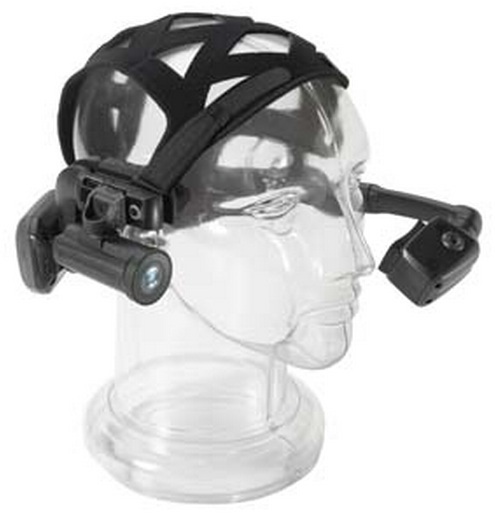
The HC1 headset computer is the first of an entirely new class of Motorola Solutions hands-free enterprise mobile computers that leverage advanced voice recognition, head gestures and video streaming to navigate applications that access and view business-critical documents and schematics. True to its field work roots, the HC1 can easily be used in harsh environments and remote locations. These are typically scenarios where access to complex graphical data, images and/or text is needed and where using a laptop or handheld device is impractical – or possibly even dangerous - without obstructing vision.
The HC1 offers the user a true “wearable” experience. Voice and head tilt commands provide the necessary means of manipulating the video screen, which receives data wirelessly. The image below shows the HC1 video screen as the wearer see’s it. As the user moves his or her head across the hardware being viewed, the schematic shown in the on screen moves in relation to where the user is actually looking.
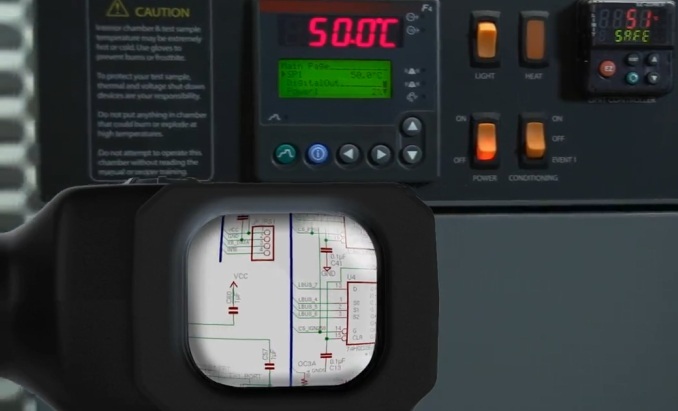
Motorola Solutions designed the HC1 specifically for field services use within the defense, utilities, telecommunications, and aerospace and aviation markets – Motorola’s core lines of business. The HC1 can be used for maintenance, repair, operations/overhaul (MRO) and training and simulation applications that improve inspection time and accuracy, reduce labor rates and increase safety. As shown in the example image above, field technicians responsible for the maintenance and repair of complex machines, vehicles electronic hardware and a huge range of other things, can receive expert assistance, information details, etc. almost instantly on-site.
Military defense forces, special public safety teams and commercial customers can practice simulated events and crisis scenarios and also perform live training with real-time trainer feedback and mission- or business-critical guidance. Construction managers, field engineers and architects will easily be able access schematics, building plans and maps, as well as annotate photos or video clips to provide proof of condition or document changes directly at any point of activity – and regardless of how dangerous the given location may be.
“Especially demanding and heavily regulated industries - such as the nuclear energy industry - require innovation to meet ever-increasing standards for safety and operational performance,” notes Dr. Andrew G. Cook, senior vice president of Operational Excellence and Innovation at AREVA. “With the Motorola HC1 headset computer, our teams are able to perform independent quality oversight at nuclear power plants without requiring a second person to enter restricted areas.” Dr. Cook also points out the significant value of the HC1’s camera functionality: “Our on-site technicians can enlist the support of our experts at the home office in real time to see exactly what is seen in the field and help them resolve conditions quickly and safely. We expect that the HC1 will provide us with measurable gains in productivity and efficiencies that will reduce radiation dose and operating costs.”
The HC1 headset computer provides hands-free mobile computing leveraging Kopin Corporation’s optical micro-display technology platform - providing the user with a view of a 15-inch laptop-size screen.
In addition to local document access, the HC1 can easily be connected via local Wi-Fi or a Bluetooth connection to other Motorola Solutions devices, such as the company’s MC75A, MC65, and ES400 smartphone, or to a mobile hotspot. Wireless connectivity allows for the push and pull of data between the headset computer and remote networks. By pairing the HC1 with a WAN device connected to a remote network, mobile workers can receive mobile gateway access to place voice calls and use GPS data.
The remote connectivity of the HC1 combined with the use of an optional camera accessory also allows the user to easily transmit pictures or videos, and enables collaboration between remote experts and field-based associates on the job site. Issues are resolved quickly and efficiently and effectively reduce travel costs and downtime, while improving worker productivity.
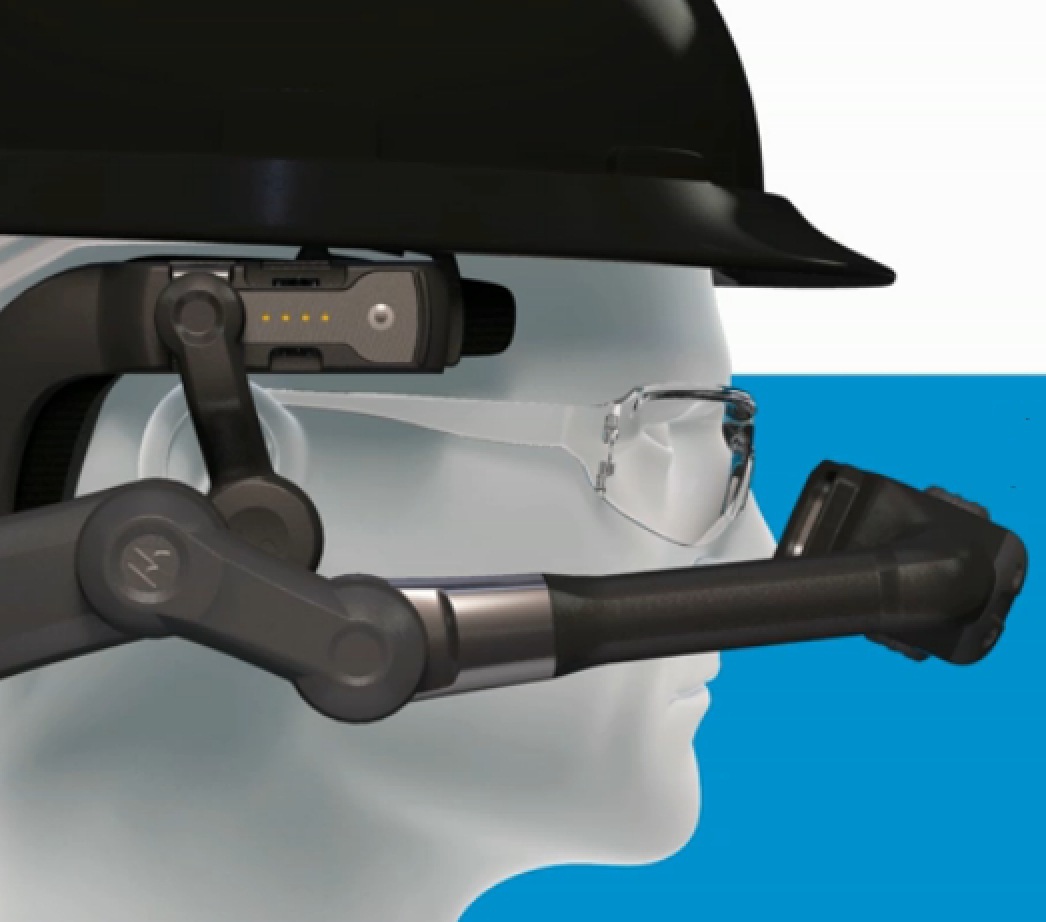
The HC1 will no doubt find itself being adapted to numerous other ecosystems other than Motorola’s core market verticals. It will be very interesting to see how the technology evolves, and how Motorola’s competitors – such as Intermec – respond to the new wireless “hardwear.”

 QUICK LINKS