What exactly is the Raspberry Pi? It is a credit-card-sized single-board computer that was developed in the U.K. by the Raspberry Pi Foundation last year. The intention for the device was to promote the teaching of basic computer science in schools.
The Raspberry Pi has a Broadcom BCM2835 system on a chip (SoC). It includes an ARM processor similar to the ones used in smartphones. It is the ARM1176JZF-S 700 MHz processor, VideoCore IV GPU and now ships with 512 megabytes of RAM. It does not include a built-in hard disk or solid-state drive, but instead uses an SD card for booting and long-term storage.
The Foundation's goal was to offer two versions, priced at $25 and $35. They started accepting orders for the higher priced model B on 29 February 2012, and the lower cost model A on 4 February 2013. The Raspberry Pi Foundation is a charity founded in 2009 to promote the study of basic computer science in schools.
From the time that the devices went on the market last February, it took one year to reach the one million mark. The expectation was that it would take almost an additional year to sell another one million units. The hope was to reach the two million mark by as early as January 2014 or as late as February 2014.
It seems that sales really took off this year. The two million mark was reached by the end of October 2013. Liz Upton from the Raspberry Pi Foundation said, "It took us almost exactly a year to sell the first million Raspberry Pis. Going on that basis, we calculated that we might, if we were lucky, reach the second million around January 2014, or slightly afterwards – we were confident we’d get there by the end of February 2014. It was a bit of a shock at the end of last week when we got the latest sales figures and discovered that the 2,000,000th Raspberry Pi was sold in the last week of October."
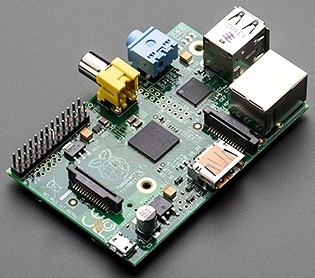
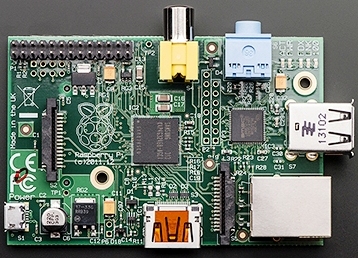
Although the device itself is small, literally the size of a credit card, it has USB ports for a keyboard and mouse, an Ethernet port, an SD card slot, and an HDMI port for connecting to a monitor or a TV. It runs a variant of the free open-source operating system Linux.
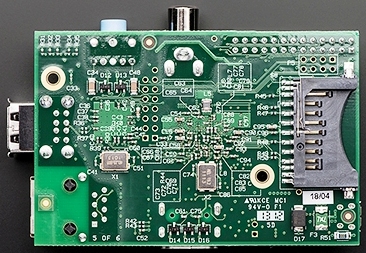
As you can see from the images below, all of the ports are strategically placed:
Initially the Raspberry Pi was manufactured in China. This quickly changed when a partnership was formed between the Raspberry Pi Foundation, RS Components and Premier Farnell. This allowed the manufacture of the device to take place closer to home.
In September 2012, manufacturing was moved to a plant in Pencoed, Wales. The plant is owned by Sony. Once the plant was moved, little time was wasted. From an original production run of 204 units a week, by April of 2013 the plant was producing nearly 40,000 units a week.
Nick Williams, who is senior product manager at Brocade, made the following comments: “Since its launch last year, the Raspberry Pi Foundation has been on a mission to transform the education experience for students, but is it delivering? The reality is that there is more work to do to ensure that schools are ready for this new wave of mini computers. Whilst the devices on offer to schools have taken a quantum leap in affordability and accessibility, schools still exist with 20-year-old networking technology and the sums just do not add up."
So you can see that while the device itself has taken off and become quite popular, there is still a lot of work that needs to be done so that it can easily be integrated into the school system.
Edited by
Cassandra Tucker 
 QUICK LINKS