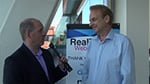
The spectrum shortage has become a central topic in the communications industry as more bandwidth-loving applications and connected devices move onto the network. There has been at least one large merger announced to address this. There’s also been lots of talk about the government allocating more spectrum, having companies cache content on the edge, and deploying more and smaller base stations to address the problem. But another, lesser discussed, way to help make more efficient use of available airspace is spectrum conditioning, explains Gordon Reichard, CEO of ISCO International LLC.
The Chicago-based company, which got its start in 1989, sells a product called Proteus that uses digital signal processing to review the spectrum and remove interference from it. Removing interference that comes from stuff like baby monitors, cable amps and WiFi hotspots in the area can help a wireless service provider shrink the size of its guard bands, which can allow for an extra carrier, and improves performance in terms of data throughput and fewer dropped calls, Reichard tells MobilityTechzone.
The company today announced that Shenandoah Telecommunications Co., which has a 3G network in the Northeast, has implemented Proteus in an effort to increase capacity, improve performance and ensure a good customer experience. As a result of the ISCO product, Shentel saw its signal strength indicator level go from 15 to 20 percent; its dropped call rate fall by 46 percent; and its blocked call rate decrease by 13 percent.
Shentel is just one of ISCO’s customers. The supplier also sells to the tier 1 cellular companies in the U.S. as well as to customers in India, Israel and Latin America, although Reichard says that at the moment most of those customers are using a product called DANF, an analog/digital precursor that has now been replaced in the ISCO portfolio with the all-digital and smaller Proteus box.
To help customers understand the kind of financial benefits they can realize from Proteus, ISCO recently introduced what it calls the ISCO Value Model, which includes the ability to increase revenue by being able to carry more voice and data traffic; recover lost capacity by conditioning the spectrum to minimize physical layer impairments caused by unlimited sources; and protect network performance through spectrum conditioning of the RF physical layer.
Reichard says wireless service providers can cache content at the edge and take all kinds of other measures to address spectrum scarcity, but “the foundation is you’ve got to have a solid physical layer.”
He adds that ISCO expects to introduce a product called ProteusONE, which will be for remote radio head or distributed architectures, this summer.
Edited by
Carrie Schmelkin

 QUICK LINKS